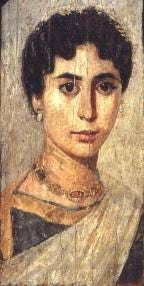
She Was There
SERMON & liturgy for May 10, 2026

There’s a name at the end of Acts 17 that most of us have never heard read out loud.
Paul has just delivered the speech of his career. He’s standing in the Areopagus, in front of philosophers and curiosity seekers, and he’s done what most preachers spend their whole lives trying to learn how to do. He’s met the room where it is. He’s quoted their own poets back to them. He’s pointed at the altar to the unknown god and said: that one. Let me tell you about that one.
Some of them mock him. Some say they’ll listen later. And then Luke, in his particular way, names two people who believed: “Dionysius the Areopagite and a woman named Damaris and others with them” (Acts 17:34).
That’s it. That’s all we get of her.
We get the man’s name and his title. He’s the Areopagite, a senator, the kind of person whose station Luke wants the reader to feel. And then we get a woman named Damaris. Luke gives no husband, no father, no occupation, no backstory. She’s there, and then the chapter ends, and we never hear from her again...
I want to sit with that for a minute.
The silence around her name isn’t unusual. It is the texture of most women’s lives in the historical record. We get the appearance and not the story. We get the fact of presence and not the shape of it. We get a name on a list and we’re supposed to keep reading.
But the ones who do family history work know what that silence means. We know what it costs. A name in a record without a story isn’t a fact. It’s a question. Who was she? What did she carry into that room? What had she already heard, already lost, already survived, before Paul started talking about the unknown god? Why did his words land in her in a way they didn’t land in others?
These aren’t romantic questions. These are the actual questions the text invites if we take women’s faith as seriously as we take men’s.
The four readings appointed for today are doing a strange and beautiful thing together. Each one is asking after presence. Each one is asking what it means to be known by God when the world hasn’t bothered to know you...
In Acts, Paul tells the philosophers that the God they’ve been worshiping without naming is the God in whom they live and move and have their being. This is the God who’s already there, who has already known them, who doesn’t depend on their recognition to be God.
In John, Jesus promises the disciples another Advocate. The Greek word is parakletos. It means the one called alongside, the one who speaks on behalf of someone who can’t speak for themselves. In legal contexts, an advocate spoke for those who couldn’t make their own defense. Jesus tells the disciples they won’t be left orphaned. The Spirit of truth is coming. This is the one who knows what they don’t yet know, who remembers what they’ve forgotten.
In 1 Peter, the writer urges the community to always be ready to give an account of the hope in them, ready for whoever asks.
And in Psalm 66, the psalmist says simply: God has not rejected my prayer. Truly God has listened.
Pull these threads together and you start to see what the lectionary is doing this week. It’s making a quiet argument about what gets remembered and what does not.
Damaris was there. Damaris believed. The Spirit of truth knew her, and knows her, even though Luke gave us only her name. The God in whom she lived and moved and had her being didn’t need her story preserved in order to know who she was.
But we did. We needed her story...
We needed it the way every generation needs its witnesses. The church needs more than one apostle to make a case. A granddaughter needs to know that her grandmother’s faith was real and not just dutiful. An heir needs to know that the line they came from had thinking, believing, weight-bearing women in it.
The loss of her story isn’t just her loss. It’s ours. We inherited a tradition with half its saints unnamed.
I think about this a lot in the work I do. It seems that genealogists of times past cherished surnames and stopped following women when their surname changed. I sit with people who hold a photograph of a woman whose name they don’t know, in a dress they can date to about 1910, and they can’t give me her first name. The men have ranks and obituaries. The women have wedding portraits and silence...
This isn’t because the women’s lives were worth less. It is because the record was made by people who didn’t think to write them down.
The Areopagus speech ends with Paul saying that God has set a day on which the world will be judged. Most preachers focus on the judgment language. I want to focus on something else. Paul says God has given assurance to all by raising Christ from the dead. Resurrection, in Paul’s mouth here, is a kind of cosmic truth-telling.
The thing that was supposed to stay buried did not stay buried. The body that the empire put in the ground came right up out of it, like a seed bursting forth from the soil. We would never expect a seed to stay buried!
And if that’s true at the cosmic scale, then it’s also true at the human scale. The voices that got buried are not finally buried. The stories that empire and patriarchy and the carelessness of record-keepers tried to silence are not finally silent. The Spirit of truth, the Advocate, the one called alongside, knows what we forgot. And the work of the church, the actual work of resurrection people, is to listen.
We listen for Damaris. We ask after her. We refuse to let the chapter end where Luke ended it. We take the fact that she believed as the start of a question, not the close of one.
There’s so many Damarises in your family tree.
In my family, we have a story about a bear. When I was a little girl, my grandfather told me a very exciting story about my ancestor, a woman alone in a logging camp, who fought off a bear with a hot poker. This story was also very disappointing to me because my grandfather could not remember which ancestor it was. Decades later, I asked a third cousin who I met through DNA if she’d ever heard a story about a bear. And wouldn’t you know, she knew the exact same story! We were able to use our relationship to restore that story to our ancestor. And now, we can say, “I can make it through anything because it is literally in my DNA to fight off a bear with a hot poker.”
There are women in your family tree who heard something true in their own century and reoriented themselves around it. You don’t know their names. Or you know the name but not the story. Or you know fragments, and you’ve made peace with the fragments because nobody taught you to push back.
Push back.
The Spirit of truth is the one who pushes back. The Advocate is on the side of the unrecorded. The God who is not far from any of us is also not far from the ones no longer here in the body. This God is not far from the ones who will come after us either. All of them belong to this God’s whole company.
1 Peter says be ready to give an account. I think the account most of us need to give is the one we never thought to ask for. It’s the account of the women whose faith made ours possible. It’s the account of the ones who were there.
Damaris was there. And we all have a Damaris in our tree.
Whoever in your line was the one who first prayed in a way nobody taught her. Whoever was the one who walked away from the church that didn’t believe in her capacity to think. Whoever was the one who carried the children and also carried a theology and never got to write it down. They were there...
The Spirit knows them. The Spirit is the keeper of the record we lost.
Our calling is to live like we believe that. We do the work of asking. We ask the older relatives the question while there’s still time. We dig in the boxes. We read the diaries. We learn the names. We say them out loud. We take women’s faith as seriously in our own century as we wish someone had taken it in the seventeenth century, or the thirteenth century, or the first century. Then we’d have more than a name and a verse.
Damaris was there.
She heard Paul say: in God we live and move and have our being. She heard him say: this is the one you’ve been worshiping all along, the unknown one. She heard him, and something in her said yes, and she went home, and the rest of her life was lived inside that yes.
Luke didn’t write that down.
But the Spirit of truth did. And on the day when every story is told and every name is held, we’ll meet her. And we’ll know her. And we’ll have time to ask her every question we should have asked while there were still people alive who remembered.
For now, we tend what we can. We name what we can. We honor what we can. And we trust that the Advocate, the Paraclete, the one called alongside, is doing the work of remembering even when we forget.
In God we live and move and have our being. We live there now. We live there especially now.
Call to Worship (from Psalm 66)
Leader: Bless our God, all peoples.
People: Let the sound of God’s praise be heard.
Leader: God has kept us among the living.
People: God has not let our feet slip.
Leader: We came through fire and water.
People: God brought us out into a wide place.
Leader: I will tell what God has done for me.
People: Truly God has listened. Truly God has not turned away.
Opening Prayer
Holy One, you are not far from any of us. You are the one in whom we live and move and have our being. You know the names we forgot. You hold the stories we never heard. This morning, gather what’s been scattered. Gather us, and gather the ones we’ve lost track of. In the name of the Risen Christ. Amen.
Prayer of Confession
God of the named and the unnamed, we confess what we’ve been taught to forget. We’ve inherited stories with the women cut out. We’ve recited histories that buried half the saints. We’ve worshiped at altars to gods we made, and we’ve ignored the altars to truths we couldn’t bear. Forgive us for the silences we kept. Forgive us for the silences we passed down. Open our ears to what the Spirit still remembers, and give us the courage to speak names aloud. Amen.
Words of Assurance
Friends, hear this good news. The Spirit of truth is with you. The Advocate has not left you orphaned. What was lost can be found. What was erased can be reclaimed. You are forgiven. You are free. You are sent. Thanks be to God.
Prayer of Illumination
Holy Spirit, Advocate, you are the one who speaks for those who couldn’t speak, who remembers what the record forgot. Open this scripture today. Open the parts we usually skip. Open us to the stories underneath. Amen.
Prayers of the People
We pray for those whose names live without their stories, whose presence in the record is brief, whose witness was real and remains untold.
We pray for the women in our families whose lives became footnotes, whose work built what we inherited, whose names appear once and then fall silent.
We pray for the church, that we’d learn to read between the verses, to ask after the ones who the text only mentions, to take their faith as seriously as we take Paul’s.
We pray for ourselves, that we’d stop being Athenians, trading old questions for new ones without ever sitting with the answer.
(silence)
Hear our prayers, the spoken and the unspoken, the remembered and the forgotten. Through Christ, who knows them all by name. Amen.
Benediction
Go now, and remember out loud. Speak the names you’ve inherited. Ask after the ones you never heard. Trust the Spirit who knows them all. And may the love of God, the grace of the Risen Christ, and the company of the Advocate go with you, and stay with you, until you come to that wide place where every story is told and every name is held. Amen.