The Beautiful Blue Pool
What a 1953 short story knows about flattering powerful men

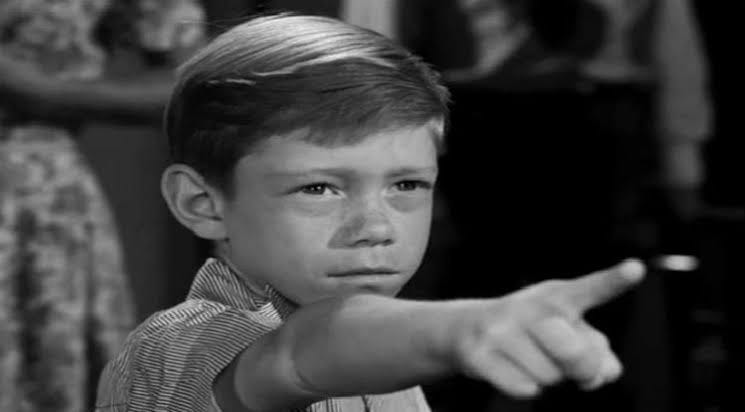
Jerome Bixby wrote a story in 1953 called “It’s a Good Life.” You may know it from the Twilight Zone, where it became one of the most quietly terrifying episodes ever filmed. A six year old boy named Anthony Fremont holds a small Ohio town hostage. Anthony has power. Real power, the kind that bends matter and erases people, and no one in Peaksville knows where it came from or how to take it back.
So, the town adapts. Adults smile at a child who has turned neighbors into gophers and buried them in the cornfield. They praise his cartoons. They tell him how good it is that he made it snow, even in July. They don’t mention the crops, even though the crops are the only thing standing between the town and starvation. Nobody corrects him. Nobody contradicts him. Survival in Peaksville means performing delight at whatever Anthony does next, because the alternative is the cornfield.
I think about Peaksville more than I’d like to admit. I think about it when I watch adults with law degrees and decades of public service stand in front of cameras. They praise the size of a pool, or a ballroom, or a flag. Their brightness is forced, the same brightness Aunt Amy used on Anthony. Thanks for fixing it. It’s so pretty now. Then they go quiet, fast. The worst thing you can do in a room with a man who has power and no boundary is give him a reason to use more of it.
Flattery is cheap. We offer it freely because it costs little. But what’s happening in these rooms is different - these yes-people have learned that contradiction carries a price they can’t predict and can’t survive.
Bixby didn’t write Peaksville as a town of cowards. He wrote it as a town of people doing math, fast, every day, about what they could afford to say out loud. They kept smiling, they had no choice.
The horror in Peaksville was never really Anthony. Anthony was a child with a wound and no boundary, and no one strong enough to give him one. His story is a tragedy, and the horror belongs to everyone else. A whole town decided collusion was wiser than truth, and kept deciding it, breakfast after breakfast, until collusion was simply how they lived. They didn’t survive by being good. They survived by being quiet, and they mistook the quiet for goodness. That mistake should keep you up at night.
Many institutions protect harmful men. Churches do it. Universities do it. Families do it for generations, until a great uncle disappears from the photographs and nobody remembers why. In every case, someone with power becomes someone the group can’t afford to upset, and the group reorganizes itself around his moods instead of around what’s true.
Peaksville never got free. Bixby refused to soften that, even though adaptations keep trying to fix it with a hopeful ending he didn’t write. Nobody arrived to save that town. It just kept shrinking, one contradiction at a time, until there was nothing left to defend but the silence itself.
We’re not Peaksville yet. We get to decide that, one election day and one sentence at a time. Remember what the smiling is actually for the next time someone asks you to admire the beautiful blue pool.
Powerful, Kate. And the comparison so very apt. I think there's a universality in it as I kept thinking of the "good Germans" just trying to get through each day and not worry about what their country was doing...