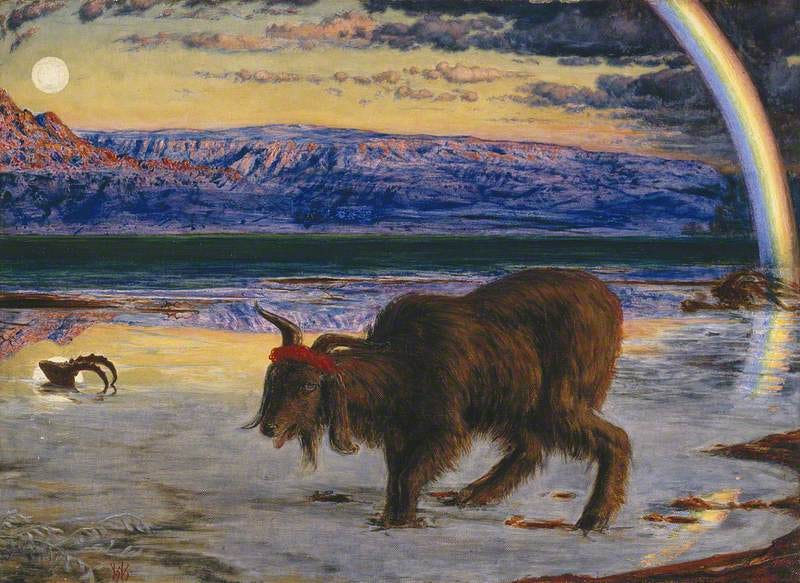
The Scapegoat's Blessing
On Mistranslation, Family Systems, and the Goat That Got Away

There is a word you’ve heard your whole life, and hiding inside it, in plain sight, is its opposite.
Scapegoat. Scape. Goat.
That’s the word “escape” with its first letter clipped off, as Shakespeare and his friends often did. Twas. Gainst. Scape.
The scapegoat is the escape-goat.
For five hundred years we’ve used this word to name the one who’s blamed, burdened, and cast out to die in the wilderness. And for five hundred years the word itself has been quietly insisting on something else entirely.
The one they cast out is the one who escapes.
✦ ✦ ✦
The word has a birthday. William Tyndale coined it in 1530, working on his English translation of the Pentateuch, very likely with the authorities already hunting him for the crime of putting Scripture into the language of the people.
When he reached Leviticus 16, he found the strange ritual of the Day of Atonement. Two goats. One sacrificed on the altar. The other receiving the sins of the people, spoken aloud and pressed onto its head, then led out of the camp and released into the wilderness.
The Hebrew assigned that second goat to Azazel, and nobody was entirely sure what Azazel meant. Tyndale read it as ez ozel, “the goat that departs.” So he wrote, in his plain and sturdy English, “the goote on which the lotte fell to scape.”
The escape goat.
Here’s the part I love. Most modern scholars think Tyndale got the Hebrew wrong. Azazel was more likely a proper name, perhaps a wilderness demon, perhaps the desolate place the goat was sent to. Some modern translations simply leave it untranslated, “for Azazel,” and let the mystery stand.
Which means our entire English concept of the scapegoat may rest on a mistranslation.
The word for the one who’s falsely blamed was itself born from a misreading.
And yet Tyndale may have lost the parsing and won the point. Even Robert Alter, our greatest living translator of the Hebrew Bible, reads the ritual his way. The goat goes free.
And the etymology goes one layer deeper, and this is the layer I can’t stop thinking about.
“Escape” comes through Old French eschaper, from a Vulgar Latin word, excappare.
Ex cappa.
Out of the cape.
The picture inside the word is this. Someone grabs you by the cloak. You slip your arms free, step out of the garment, and run. Your pursuer is left standing there holding the cloth, and you’re gone.
To escape, at its root, means to leave behind the garment somebody else grabbed you by.
Now put the whole word back together.
The scapegoat is the one who slips out of the cloak of blame and walks away, leaving the accusers holding nothing but fabric.
I needed the word to tell me this, because everything else in my experience says the opposite.
In modern language, nobody wants to be the scapegoat. The scapegoat is the one blamed, shamed, accused, and loaded down with failures that belong to other people. The scapegoat carries weight it never earned.
Most of us spend our lives trying not to be that person. We want to be understood. We want to be judged fairly, our work seen for what it is, our mistakes measured in proportion. We want other people to carry their own grief instead of handing it to us like luggage at the door.
But sometimes life doesn’t work that way.
Sometimes a community arrives at a place where it can’t face its own dysfunction, its own contradictions, its own buried failures. And rather than tell the truth, it quietly chooses a person to carry the blame.
Every family tree I have ever traced has one. A sibling nobody mentions. A son the obituaries skip. The family didn’t lose them. The family handed them the cloak, and the role stitched into it was to leave.
Family systems theory has a name for this. In an anxious system, tension rarely stays where it actually belongs. It gets displaced onto a single person, who becomes the identified problem. If the family (or organization) can convince itself that one child is rebellious, or one sibling is unstable, or one relative is the source of every conflict, then nobody else has to look at the system itself.
The scapegoat serves a purpose: they absorb anxiety that belongs to everyone. They become the explanation for problems they didn’t create. And once the scapegoat has been named, something almost miraculous happens.
People who disagree about everything suddenly agree. People who’ve been at each other’s throats unite. People who share no common vision discover a common enemy. The scapegoat becomes social glue.
This causes a triangle. When the tension between two people grows unbearable, they pull in a third. The third person stabilizes the relationship, but the stability is borrowed, not earned. The system looks calmer because the anxiety finally found somewhere to land.
The problem, of course, is that the scapegoat was never the problem. Neither does the scapegoat take the problems with them. The secrets remain. The unhealthy patterns remain. The institutional failures remain. The unresolved grief remains. The dysfunction simply becomes harder to see, because everyone is staring at the person who they blamed.
This is why being scapegoated cuts so deep. It isn’t merely rejection. It is rejection cloaked in lies. You aren’t being cast out for something you actually did. You’re being cast out because other people need a story that lets them avoid reality. Your exile is the price of their comfort.
They grab you by the cloak. And the cloak they grab was never even yours. It’s a garment they wove themselves, out of their own fears and failures, and draped over your shoulders so they wouldn’t have to feel the weight of their own hurts.
That’s a painful thing. I won’t pretend otherwise. But. Their grip is on the cloak. Not on you.
Because once the scapegoat slips free, something else becomes possible.
The scapegoat is no longer responsible for managing everyone else’s emotions. They are no longer required to maintain the illusion. The scapegoat is no longer trapped inside a system that runs on denial. You may lose relationships, status, influence, and belonging. Those losses are real, and they deserve to be grieved.
But the scapegoat gains something the people left behind rarely have. Wisdom.
One of the hardest lessons in family systems work is this. Differentiation feels like betrayal to the people who benefited from your compliance. The moment you stop carrying the group’s anxiety, the group experiences your freedom as a threat. You might be seen as selfish. They call you the problem for refusing to keep being the problem. The system pushes back because the system wants equilibrium, even when that equilibrium is killing everyone in it.
The people who remain keep performing the same roles. They keep telling the same stories. They keep guarding the same secrets. The one who steps out of the cloak is suddenly free to see things as they are.
Where do the most important moments in scripture happen?
Not in the temple. Not in the palace. Not at the center of power.
In the wilderness. Hagar meets God in the wilderness. Moses meets God in the wilderness. Elijah, Jacob, John, Jesus. Again and again, God’s best work happens outside the camp, beyond the walls, past the edge of the approved map.
The wilderness is where illusions die and where identities get rebuilt.
The wilderness is where you discover who you are apart from everyone else’s expectations.
So I’ve come to believe the word was telling the truth all along.
The community believes it saves itself by sending the scapegoat away. The irony is that the scapegoat may be the only one who actually gets saved. The escape-goat walks away. The people believe they got rid of their problem. The scapegoat wakes up one morning and realizes the problem was never them.
Remove the scapegoat, and the dysfunction doesn’t disappear. It relocates. Another person gets blamed. Another conflict erupts. Another crisis arrives on schedule. The people stay behind with the same unresolved conflicts. The same fears. The same resentments. The same inability to tell the truth out loud. They sacrifice the chosen goat.
The symptoms move because the symptoms were never the disease.
If you’ve been scapegoated, I don’t want to minimize what it cost you. It hurts so badly. It leaves scars that show up in the strangest weather.
But maybe there’s another way to hold the story. Maybe the language itself has been trying to hand it to you. Maybe the question isn’t, “Why did they do this to me?” Maybe the better question is, “What freedom became available once they did?”
What if being cast out released you from a role you were never meant to play? What if being blamed for everything freed you from carrying what was never yours? What if the wilderness was a gift?
We never did learn what Azazel means. A demon. A cliff. A place so far out it has no other name. The scholars are still arguing, and the word is still keeping its secret.
But I think Azazel knew something the camp didn’t. Azazel knew the goat was coming out alive.
Somewhere out past the camp, the accusations lose their grip. The stories stop holding. The borrowed sins fall away like a garment sliding off your shoulders.
Because that’s what they always were: a cloak somebody else wove and somebody else grabbed. They’re still standing back there, all of them, clutching the empty fabric and calling it you.
And you?
You’re the escape-goat. You’re already gone.
Image Credit: The Scapegoat, William Holman Hunt